Real place · Southern Mesopotamia, near the ancient Persian Gulf coast (modern Iraq)
Ur
The Sumerian moon-city, where writing learned to count
- Era
- Founded c. 3800 BCE; Third Dynasty (Ur III) under Ur-Nammu and Shulgi, c. 2112–2004 BCE
- Region
- Southern Mesopotamia, near the ancient Persian Gulf coast (modern Iraq)
- At its peak
- Around 65,000 at the height of Ur III
- Language
- Sumerian (state and temple); Akkadian increasingly in daily life
What it was
Ur sat on the Euphrates in southern Sumer, close enough to the head of the Persian Gulf in its day to be a working port. It was a city of the moon-god Nanna (Akkadian Sîn) and one of the oldest continuously inhabited settlements in Mesopotamia.
Two periods stand out. The Early Dynastic Royal Cemetery (c. 2600 BCE), excavated by Leonard Woolley in the 1920s and 1930s, revealed the now-famous tomb of Queen Puabi - a woman buried with a gold headdress, lapis-and-carnelian jewelry, a lyre inlaid with a bull's head, and a substantial retinue of attendants who appear to have followed her into death.
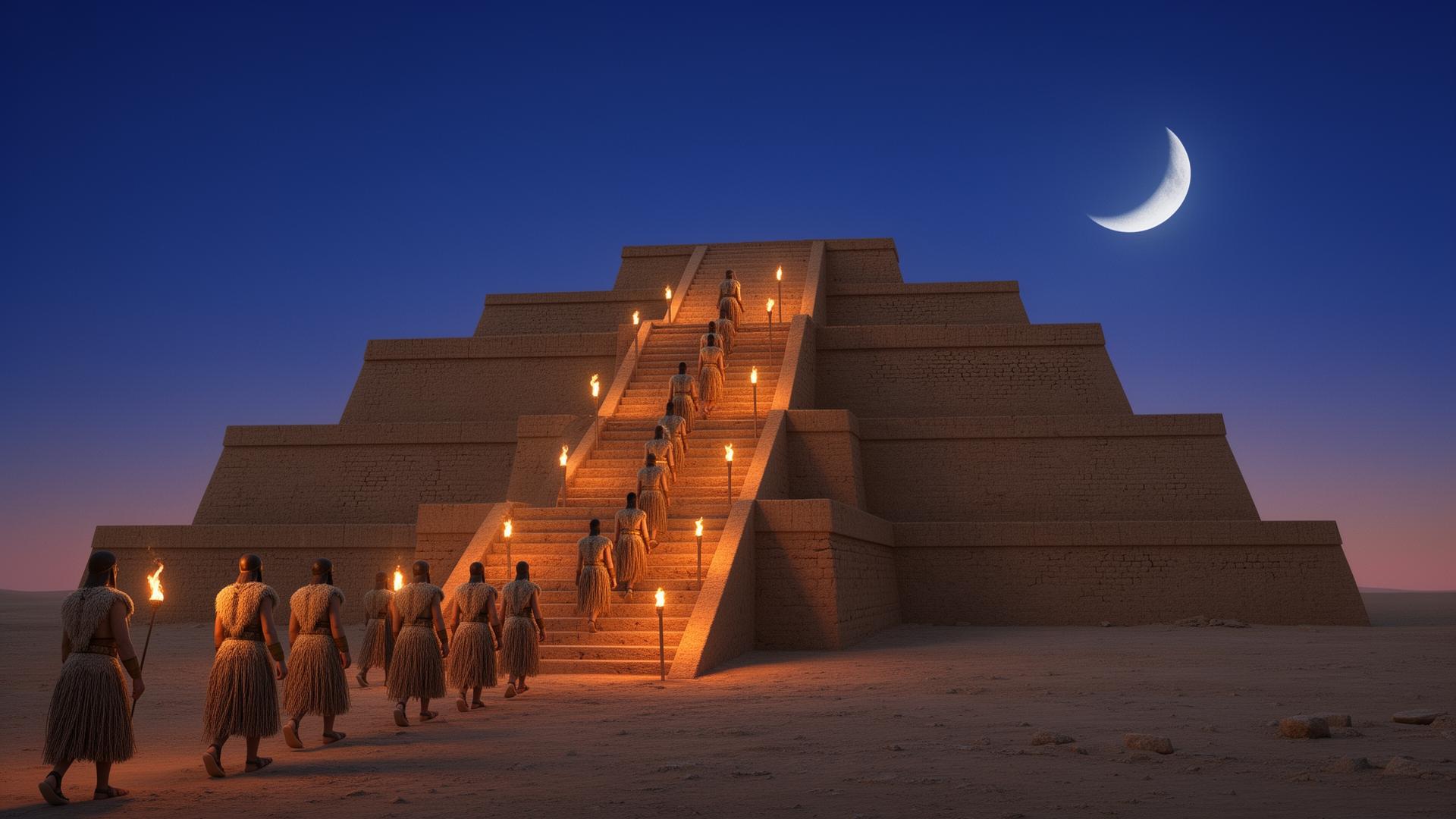
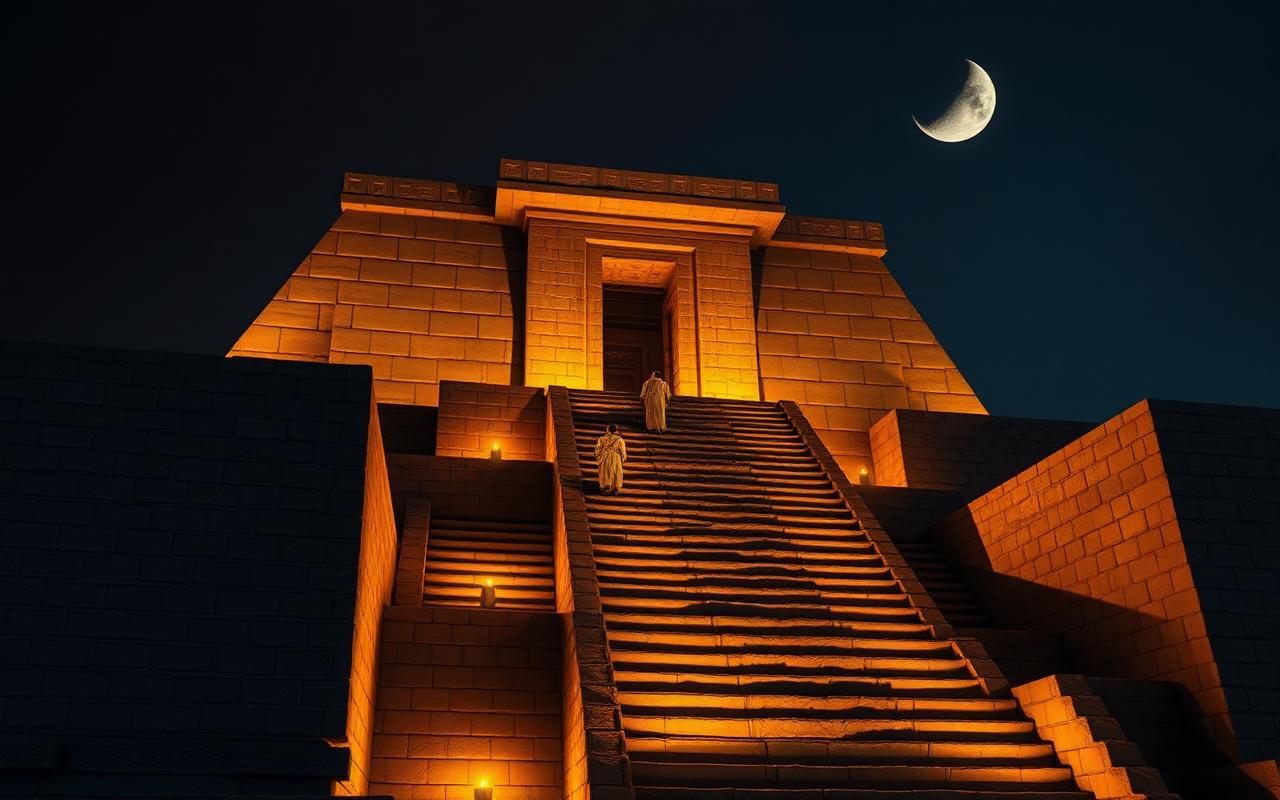
Then in the late third millennium came the Third Dynasty of Ur - 'Ur III' - under Ur-Nammu and his son Shulgi. They built the Great Ziggurat of Ur, codified one of the earliest surviving law collections (the Code of Ur-Nammu), and ran a tightly bureaucratic empire whose archives have left tens of thousands of administrative tablets. This is when Sumerian literature was largely fixed in writing.
A day here
From dawn until the lamps go out
You wake at first light on a reed mat in a small mudbrick house off one of Ur's narrow lanes. A neighbor is already baking flatbread on the hot wall of a clay oven. You eat the bread with a cup of beer, a few dates, and an onion.
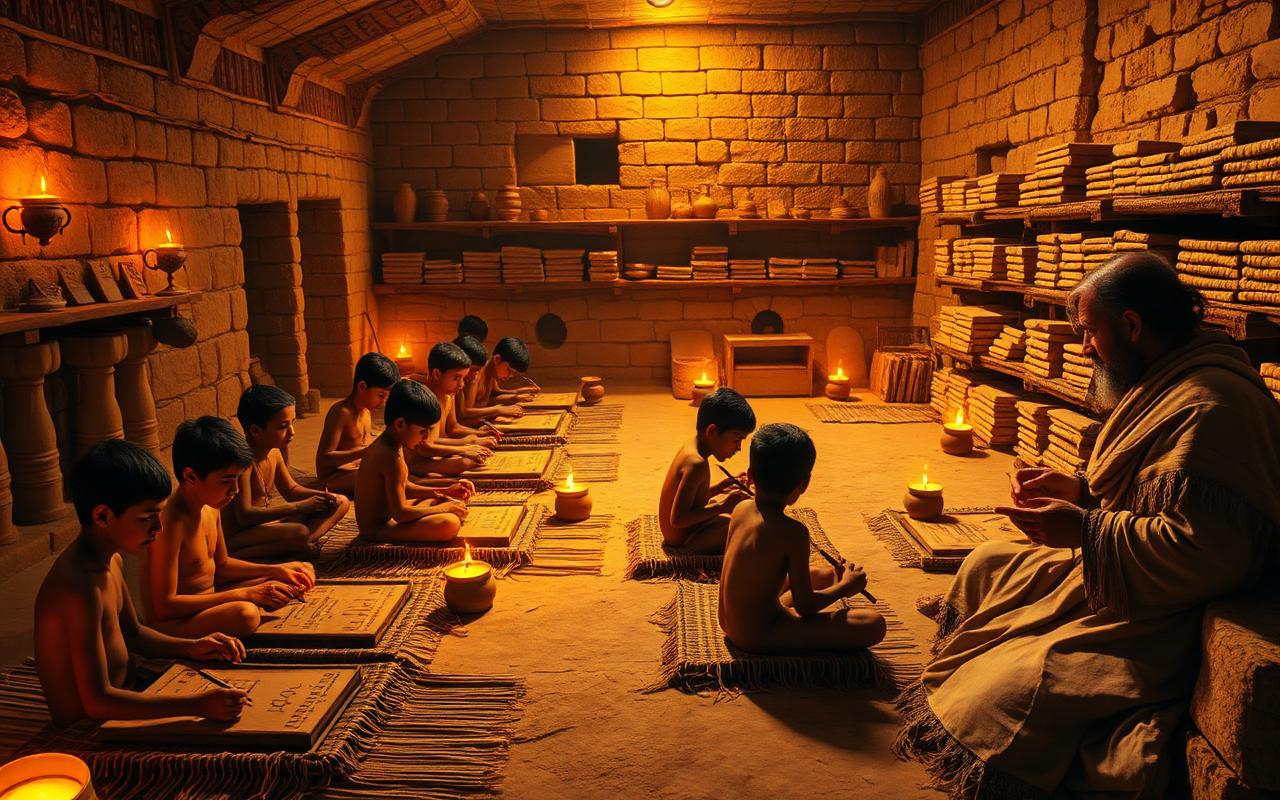
If you are a junior scribe at the é-dub-ba - the 'tablet house' - you walk to school carrying yesterday's homework tablet under your arm, hoping the lines of cuneiform are straight enough to pass the master without a beating. The morning is spent copying lists of words: kinds of fish, names of trees, the standard professions of the city.
Midday you go to the harbor district. A boat has come in from Dilmun (modern Bahrain) with copper, beads, and a few exotic shells. The dock smell is bitumen, fish, and the river. You take a stew of barley, leeks, and salted river fish at a tavern run by a woman called Kubatum.
The afternoon you spend at the temple of Nanna, on the lower terraces of the ziggurat. A trader is having a contract drawn up - silver weighed out in shekels on a balance, witnessed by three men whose seal-impressions are rolled into the wet clay. You watch and learn.
At evening, you climb partway up the ziggurat for the air. The plain stretches green and brown to the horizon; the canals catch the last light. The high terrace, where only the high priestess goes, is silent. The crescent moon - Nanna himself - comes up over the date palms. The lamps in the courtyards below go on one by one.
The architecture
How it was built
The people
Who lived here
Ur III society was the most bureaucratic the world had yet seen. Tens of thousands of administrative tablets record sheep counted, beer rationed, silver weighed, and laborers assigned. Scribes - almost always men - were a privileged professional caste; literacy was rare and powerful.
Above the scribes sat the king, the royal family, and the high priestess of Nanna (often a king's daughter - Enheduanna, daughter of Sargon of Akkad, is the first author in world history whose name we still know).
Most people farmed barley and tended date palms in the irrigated plain around the city. A substantial slave population - debt-slaves and war captives - worked alongside them. Free craftspeople, weavers, brewers (largely women), boatmen, and traders made up the rest of the population.
What's real
The ziggurat (still standing, partly restored), the Royal Cemetery and Puabi's tomb (in the Penn Museum and the British Museum), the Code of Ur-Nammu, the school tablets, Enheduanna's authored hymns. Ur III administrative documents are some of the best-attested in any ancient civilization.
What's reconstructed
The everyday sound and smell of the city, the precise look of the upper ziggurat shrine, the population figure. The day-in-the-life is grounded but composite.
What's invented
Nothing here. Where a detail is uncertain it's flagged.
Sources & further reading
- Woolley, L. - Ur Excavations (1934–1976, multiple volumes)
- Crawford, H. - Ur: The City of the Moon God (2015)
- Roth, M.T. - Law Collections from Mesopotamia and Asia Minor (2nd ed., 1997)
- Black, J., Cunningham, G. et al. - The Literature of Ancient Sumer (2004)