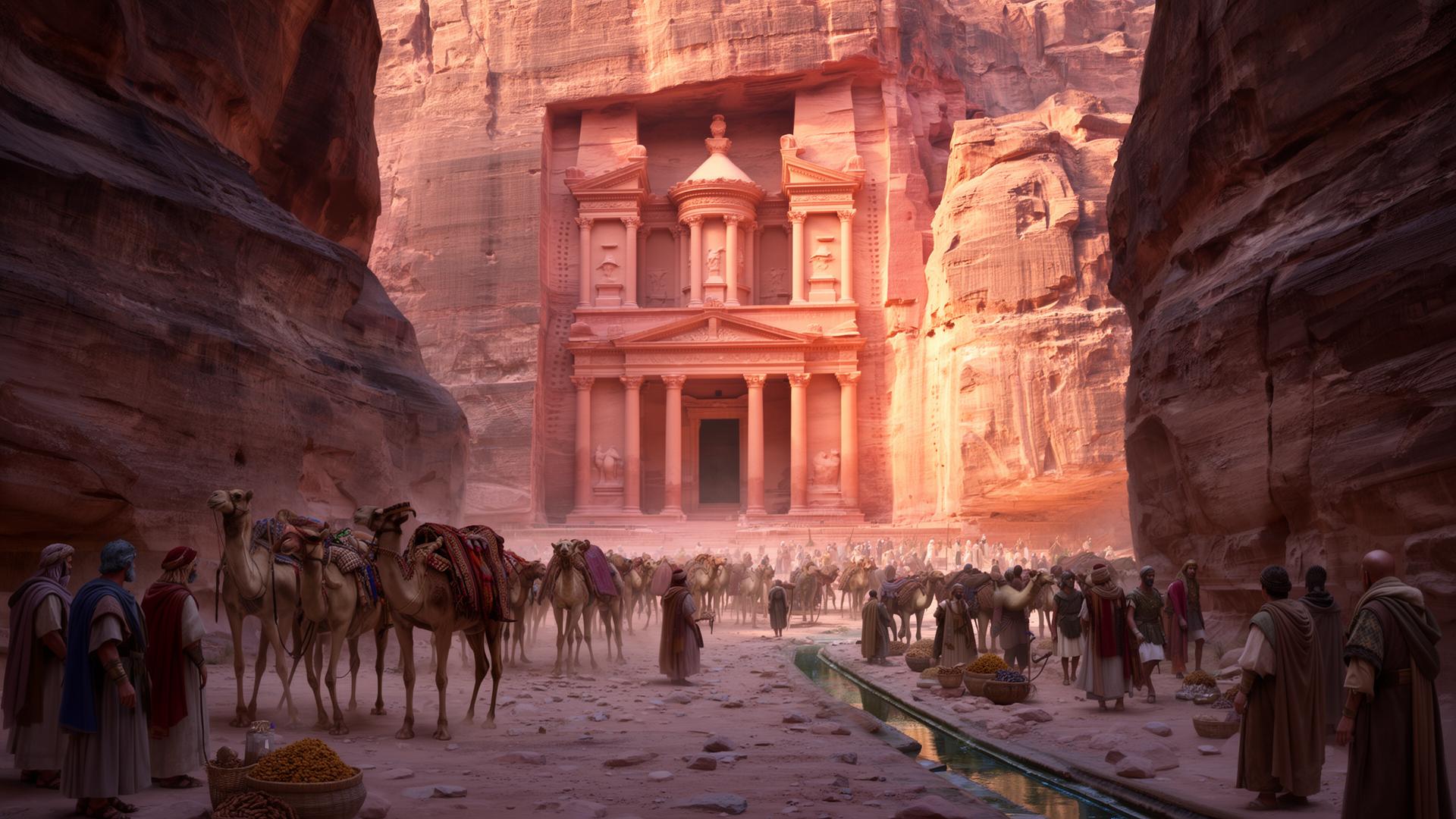
Real place · Wadi Musa, southern Jordan
Petra
The rose-red city carved into a canyon
- Era
- Nabataean capital c. 4th c. BCE – 106 CE; peak under Aretas IV, 9 BCE – 40 CE
- Region
- Wadi Musa, southern Jordan
- At its peak
- Around 20,000–30,000 at its height
- Language
- Nabataean Aramaic (written); Greek and Arabic widely spoken
What it was
Petra was the capital of the Nabataean kingdom - Arab merchants who controlled the long incense and spice routes between southern Arabia, Egypt, the Levant, and the Mediterranean. Their genius was water: in a desert canyon, they engineered cisterns, channels, and dams that supported a city of tens of thousands.
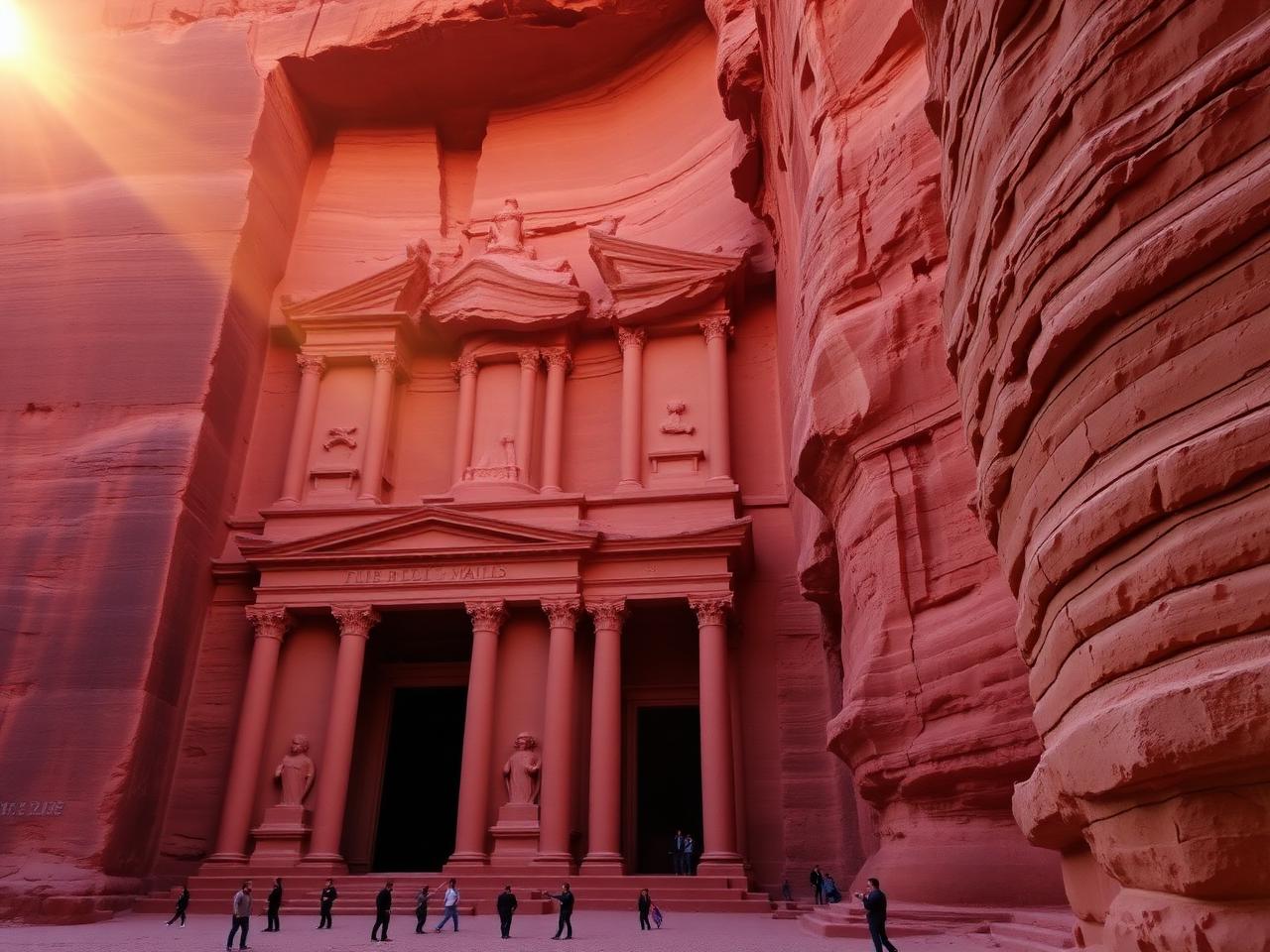
The famous façades - the Treasury (Al-Khazneh), the Monastery (Ad-Deir), the royal tombs - are tombs and temples cut directly into the sandstone cliffs. Behind them was a working city of free-standing houses, markets, baths, and a colonnaded main street, most of which has eroded but is being slowly uncovered.
It was annexed by Rome in 106 CE and renamed Arabia Petraea. It declined as sea routes overtook the caravan trade, was damaged by earthquakes, and was effectively forgotten by the wider world until Johann Ludwig Burckhardt reached it in 1812.
A day here
From dawn until the lamps go out
You wake before sunrise in a flat-roofed house on the slope above the colonnaded street, to the sound of camels grumbling at the city gate as the night caravan from Hegra is unloaded.
Breakfast is a flat round of barley bread, goat's-milk yogurt, olives, dates from the oases below, and tea-like infusions of dried mountain herbs. The well-off add honey and a strip of dried lamb.
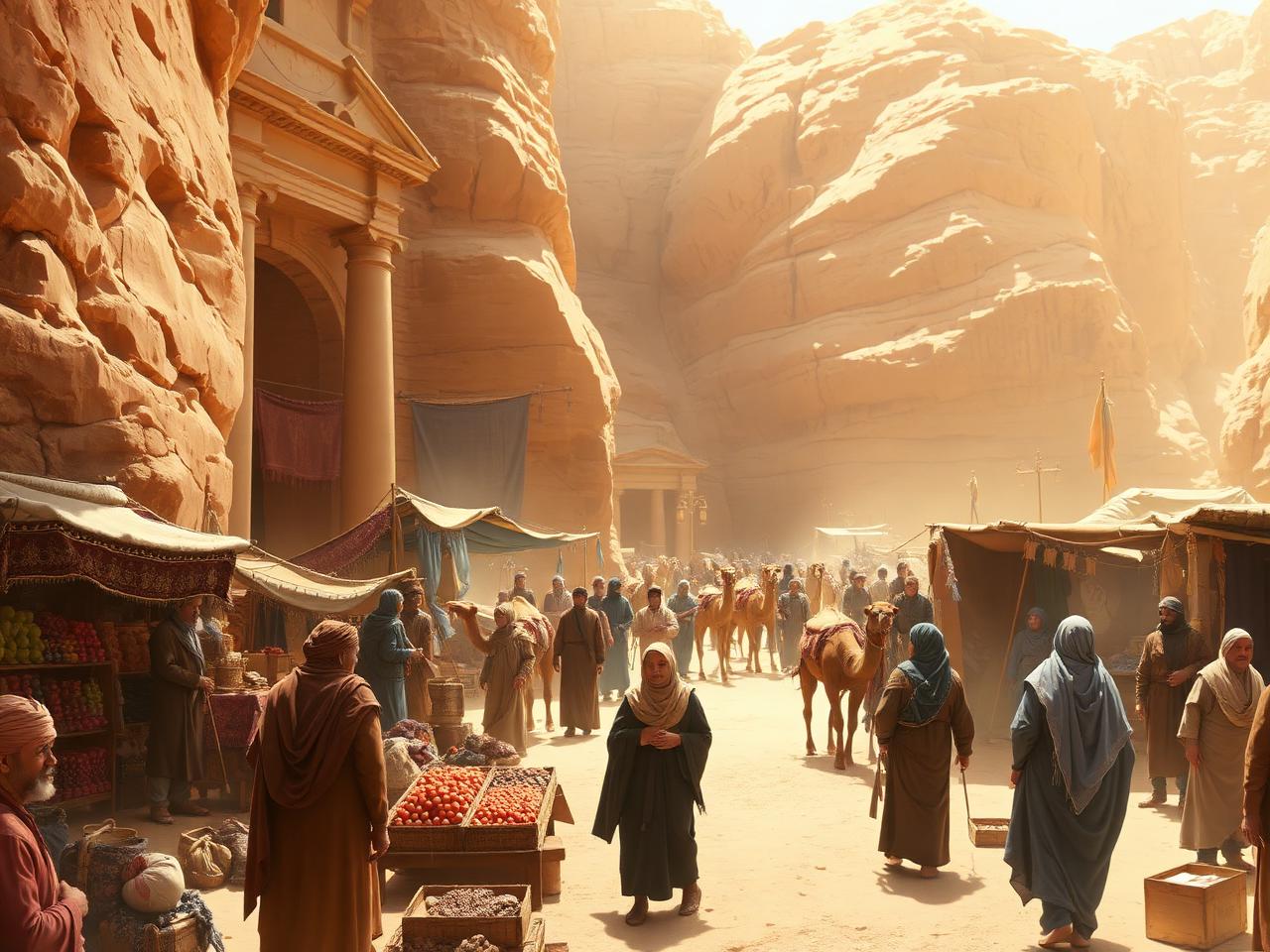
By mid-morning the Siq is a moving wall of sound - camels' bells, the soft Aramaic of caravan masters, the harder Greek of an envoy from Bostra, the smell of frankincense resin warming in the sun. You spend the morning in the market under cloth awnings, weighing bags of myrrh, indigo cloth, pearls from the Persian Gulf, silver from Spain that came east through Alexandria.
Midday is for shade and the bath. The afternoon belongs to negotiation: tariffs at the customs house, a grievance taken to a Nabataean judge in a chamber off the main street, a sacrifice arranged at the temple of Dushara, the chief god, whose presence is a great unworked block of stone.
At dusk the cliffs glow as if the sandstone were lit from inside. Dinner is roasted kid with cumin and pomegranate, lentil and barley stew, and a wine pressed in the small terraced vineyards above the city. Lamps go up along the colonnaded street and the city hums until late.
The architecture
How it was built
The people
Who lived here
Society was led by a Nabataean royal house - Aretas, Obodas, Rabbel - supported by a wealthy merchant aristocracy whose tombs line the cliffs. Below them were artisans, caravan workers, water engineers, and slaves.
Religion centered on Dushara (a male sky/mountain god) and al-Uzza (a goddess often identified with Aphrodite by Greek observers). The Nabataeans famously represented their gods aniconically - as carved blocks of stone rather than human figures.
Women had unusual legal standing for the period: they could own property and run businesses. Inscriptions name female Nabataean rulers reigning jointly with their husbands.
What's real
The city, the carved façades, the water engineering, the trade network, the kings, the religion, the language. All documented from inscriptions, archaeology, and outside writers (Strabo, Diodorus Siculus, Pliny the Elder).
What's reconstructed
The peak population, the precise look of the now-eroded free-standing buildings, the day-to-day texture of the market, the exact menu. The day-in-the-life is grounded but composite.
What's invented
Nothing on this page is invented. Where archaeology is silent, the text uses qualifiers.
Sources & further reading
- UNESCO World Heritage - Petra
- Taylor, J. - Petra and the Lost Kingdom of the Nabataeans (2001)
- Bedal, L-A. - The Petra Pool-Complex (2003)
- Strabo, Geography XVI.4; Diodorus Siculus XIX.94–100