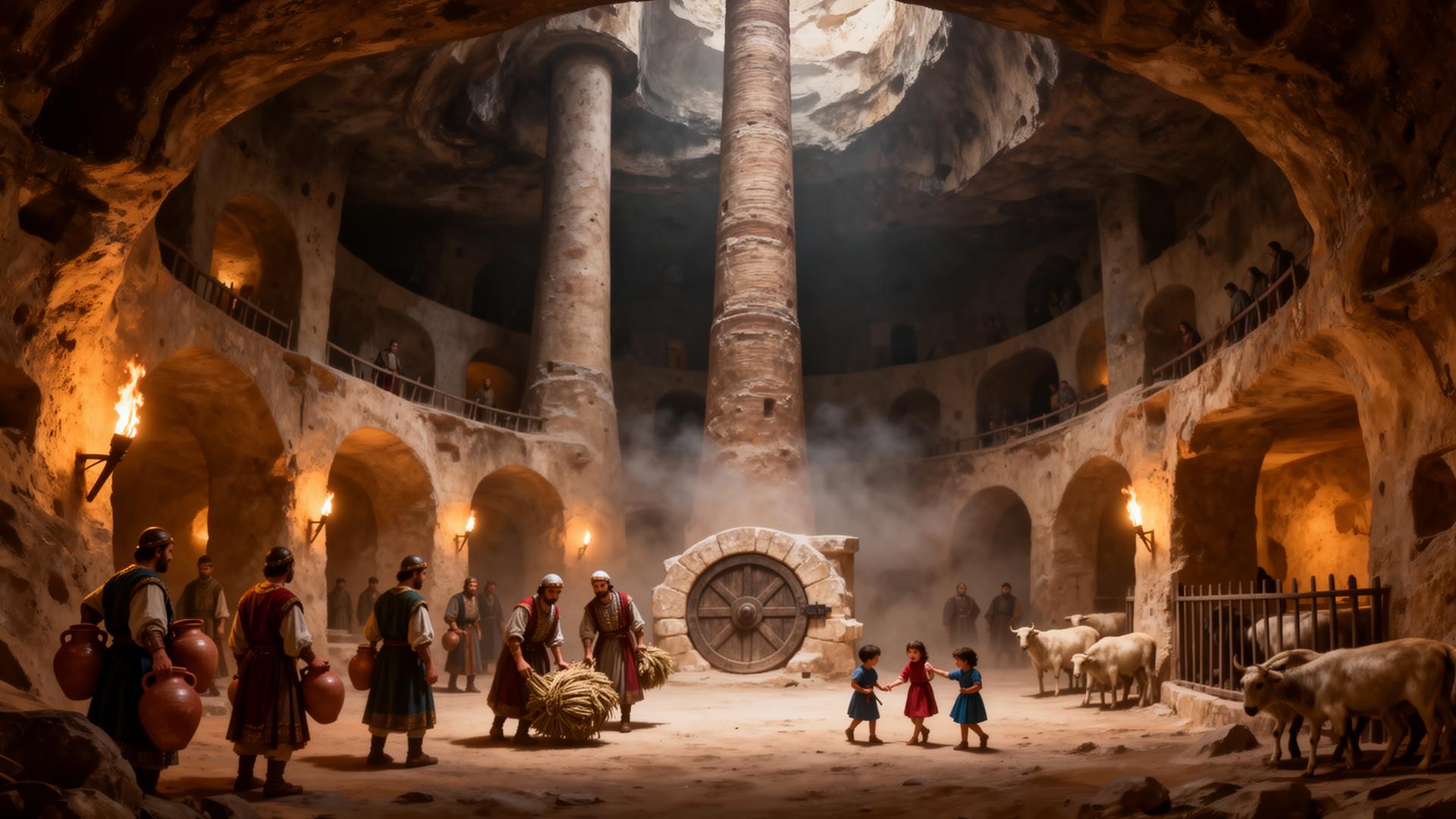
Real place · Cappadocia, central Anatolia (modern Turkey)
Derinkuyu
The hidden city beneath Cappadocia
- Era
- Carved c. 8th–7th c. BCE (Phrygian); expanded under Byzantine Christians, 5th–10th c. CE
- Region
- Cappadocia, central Anatolia (modern Turkey)
- At its peak
- Up to 20,000 people with livestock and provisions
- Language
- Greek and Cappadocian Greek, later Turkish
What it was
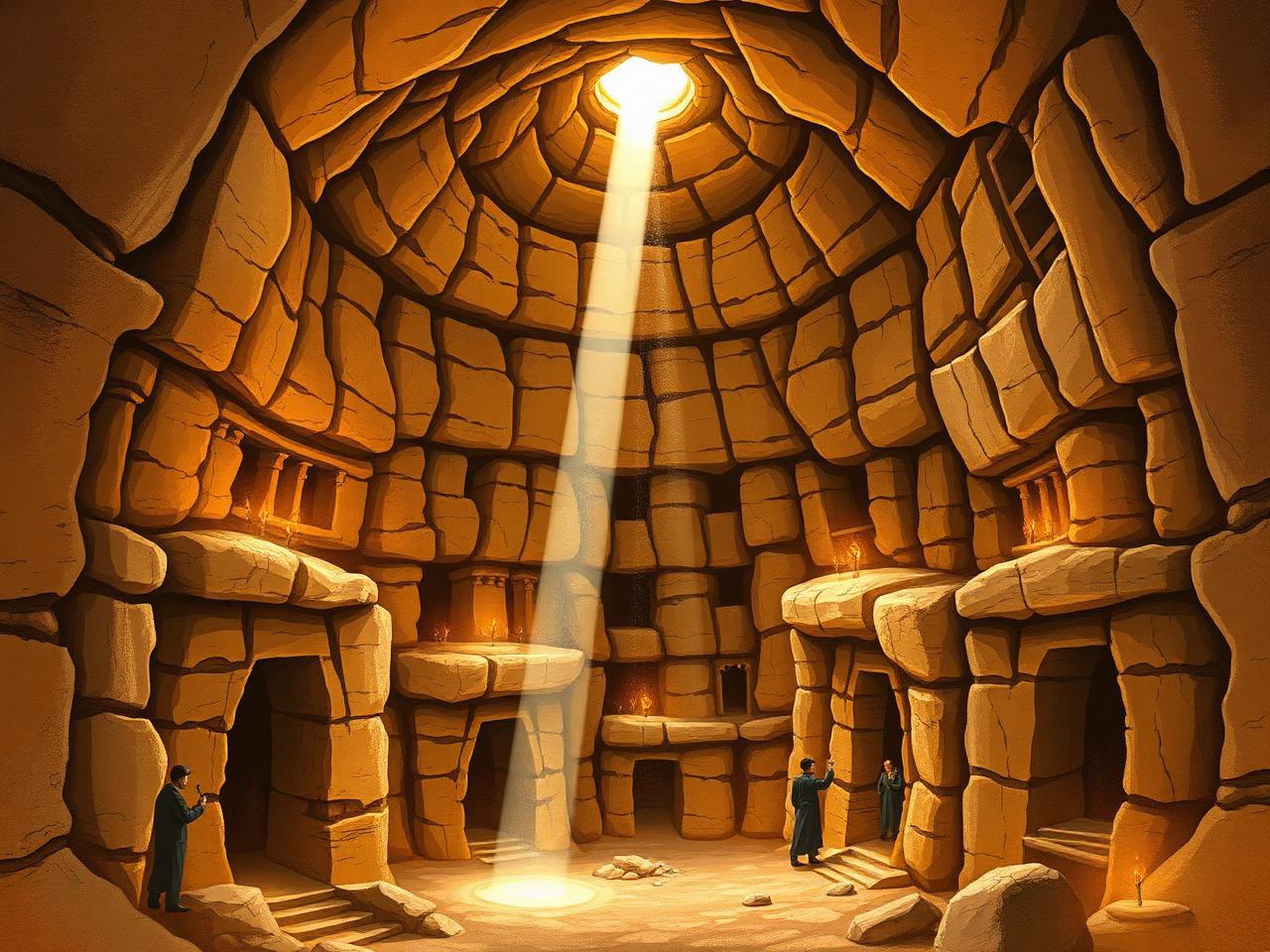
Derinkuyu is not a legend. It is a real, multi-level subterranean city beneath the town of the same name in Cappadocia, dug down through soft volcanic tuff to a depth of roughly 85 meters across at least eighteen levels - though only the upper eight are open to visitors today.
It was rediscovered in 1963 when a local homeowner, knocking down a basement wall during a renovation, broke through into a passage that led to a hidden room - and then to corridors, and stairwells, and an entire planned city.
At its peak it could shelter around 20,000 people together with their livestock and food stores. Massive circular stone doors, each weighing several hundred kilos, could be rolled into place from inside to seal off corridors. Long vertical ventilation shafts - over a hundred of them - pulled fresh air down to the deepest levels.
A day here
From dawn until the lamps go out
Dawn does not exist here in the usual sense; you wake to torchlight and the smell of woodsmoke and animal warmth from the stable two levels down. The air is cool and steady, about 13°C year-round.
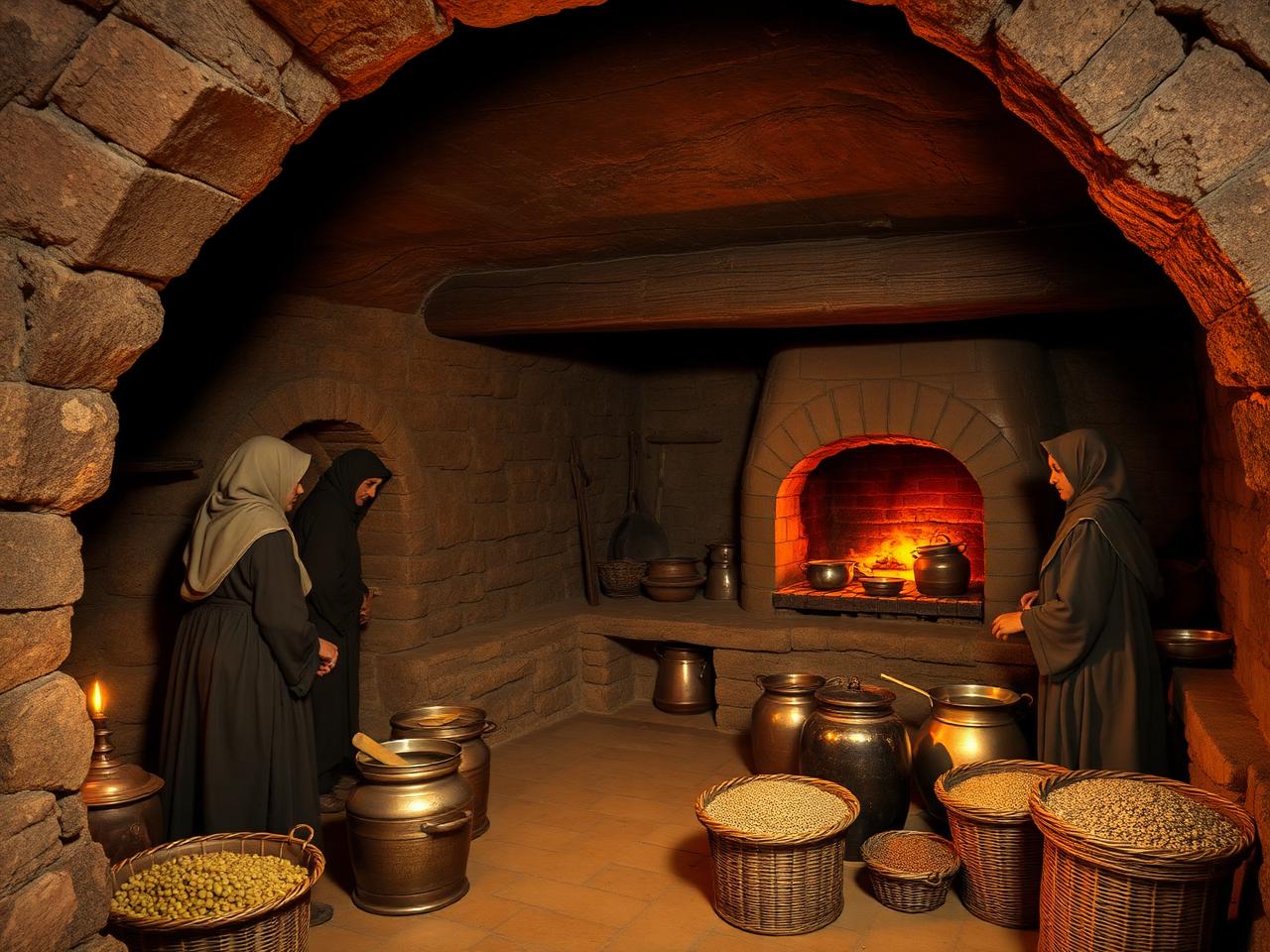
Breakfast is flatbread baked in a communal clay oven, soft white cheese, olives, and a cup of weak wine cut with water. The wheat came up from a granary cut into level four; the wine was pressed last autumn in a press carved directly into the rock.
The middle of the day is taken up by work that the surface can no longer be trusted to provide: weaving by lamplight, repairing tack, copying a psalter in a small monastic cell. Children gather in a vaulted chamber that functions as a schoolroom.
In the late afternoon someone climbs the long shaft-stair to a hidden upper exit, listens, and comes back down with the news that the raiders have passed. The great stone wheel at the second level is rolled back. By evening, families are sitting at the entrance of their compartments eating lentil stew and barley porridge, telling the day's small stories. The torches are doused one row at a time.
The architecture
How it was built
The people
Who lived here
By the Byzantine period the inhabitants were Cappadocian Greek Christians. Derinkuyu was one of dozens of underground cities in the region - Kaymaklı, three kilometers north, was connected to it by a tunnel some eight kilometers long.
These were not permanent residents in the modern sense. Most people lived in surface villages and descended only when raids - Arab in the 7th–10th centuries, later Mongol and Turkish - threatened. The city could be self-sufficient for months.
Inside you would find a complete civil society in miniature: stables, wineries, oil presses, granaries, refectories, a cruciform church on the seventh level, baptisteries, missionary schools, and small monastic cells.
What's real
The city itself, the eighteen levels, the stone rolling doors, the ventilation shafts, the cruciform church, the connection to Kaymaklı, and the 1963 rediscovery - all documented and visitable today.
What's reconstructed
The exact peak population (estimates range from 3,000 to 20,000), the precise dates of original excavation, and what daily life sounded and smelled like. The day-in-the-life section above is reconstruction, not transcription.
What's invented
Nothing on this page is invented. Where details are uncertain, they're marked as estimates.
Sources & further reading
- UNESCO - Göreme National Park and the Rock Sites of Cappadocia
- Turkish Ministry of Culture - Derinkuyu and Kaymaklı site reports
- Bixio, R. et al. - 'Cappadocia: Schede dei siti sotterranei' (Hypogean Archaeology)