Mythic · fiction · Beyond the Pillars of Heracles (somewhere west of Gibraltar), per Plato
Atlantis
Plato's drowned island, sole source of the legend
- Era
- Said by Plato to have sunk c. 9600 BCE - written about by him c. 360 BCE
- Region
- Beyond the Pillars of Heracles (somewhere west of Gibraltar), per Plato
What it was
Atlantis appears in exactly two surviving ancient texts: Plato's Timaeus and his unfinished Critias, written around 360 BCE. There is no earlier source - no Egyptian record, no Sumerian tablet, no Phoenician inscription. Every later mention, ancient and modern, traces back to those two dialogues.
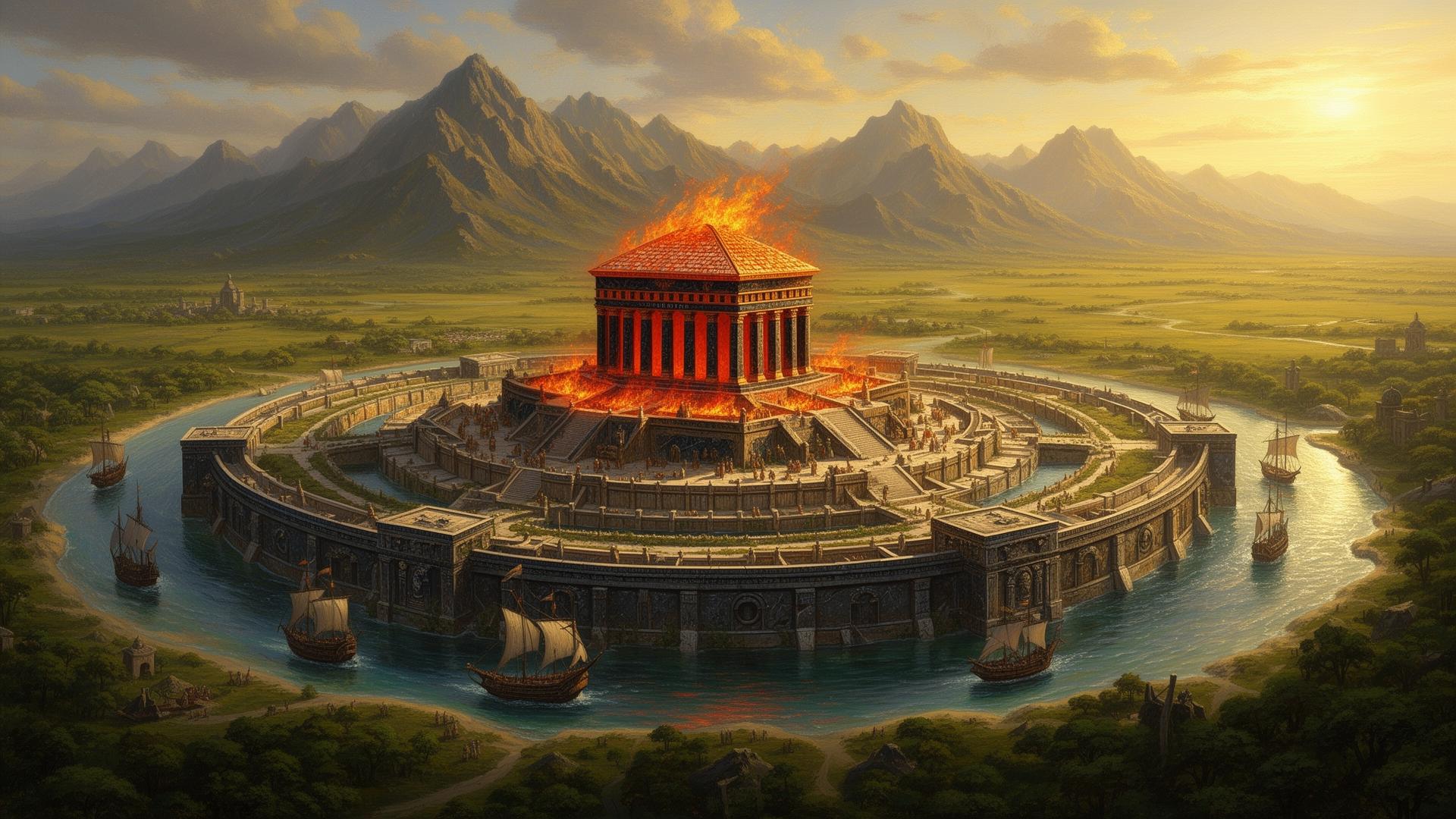
Plato's Atlantis is an island larger than Libya and Asia combined, beyond the Pillars of Heracles, an immensely wealthy maritime empire ruled by descendants of Poseidon. Its capital is a series of concentric rings of land and water surrounding a central acropolis whose temple is roofed in a precious metal called orichalcum 'that flashed like fire.' Nine thousand years before Plato's day it attacked an idealized proto-Athens, was defeated, and was destroyed in a single night and day by earthquake and flood.
Most scholars read Atlantis as a deliberate philosophical fiction - a foil that Plato invented to dramatize the dangers of imperial overreach in contrast to the virtuous, austere city of his Republic. He gave it just enough invented historicity (Egyptian priests as supposed sources, exact numbers, geography) to make the lesson land. The dialogue Critias breaks off mid-sentence; Plato never finished the story.
A day here
From dawn until the lamps go out
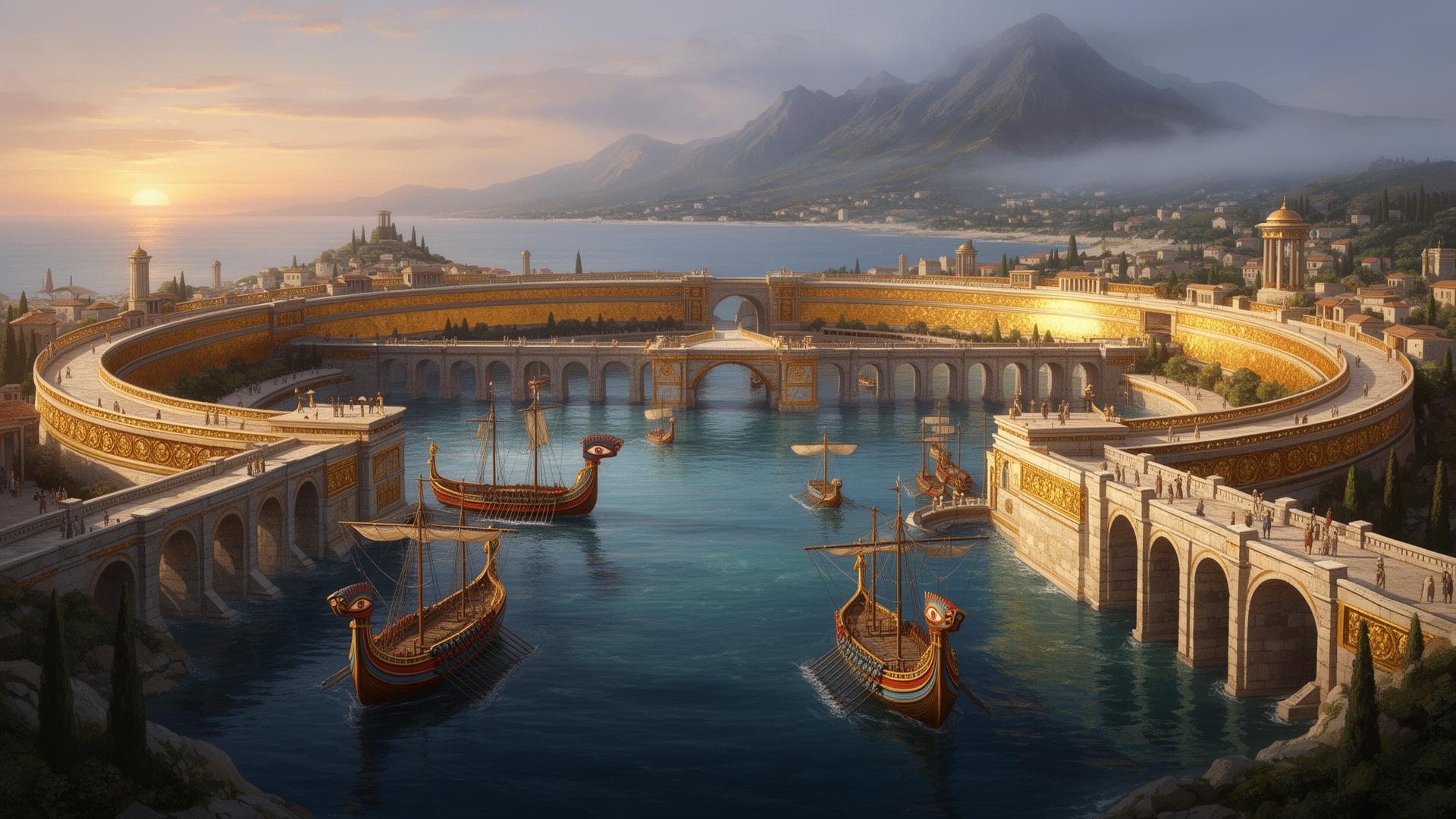
Imagine you wake in a flat-roofed house on one of the outer rings of land in Plato's city. Bronze sheathes the outermost wall, tin the second, and the innermost wall around the central island flashes with orichalcum. A canal one stadion wide separates you from the next ring.
Trireme oars beat in the harbor. Plato says the city had a thousand ships and that a constant trade brought tribute from across the western ocean. You eat a breakfast of bread, olives, dried fish, and watered wine.
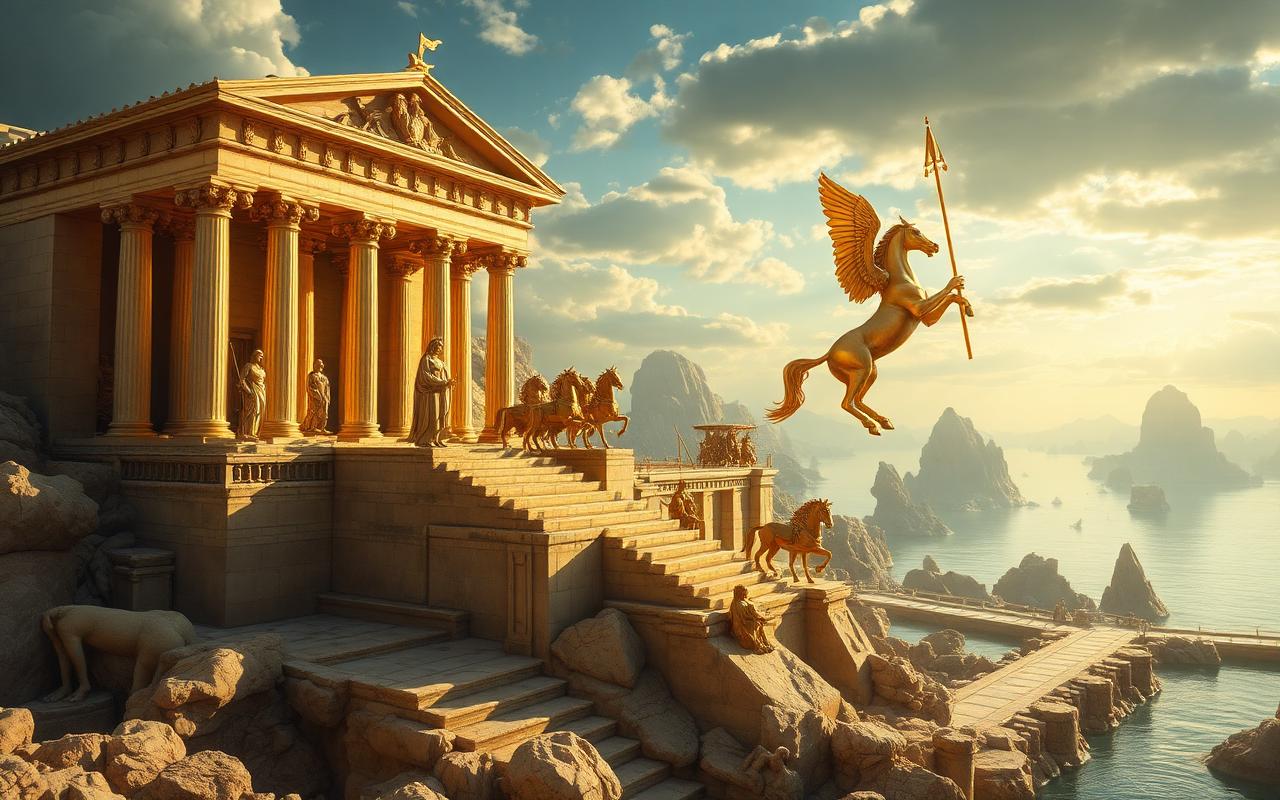
Midday you cross by one of the great bridge-tunnels to the central island. The royal palace and the temple of Poseidon stand at the top, surrounded by a grove of orichalcum statues - including the great one of Poseidon in his sea-horse chariot, head touching the roof.
In the afternoon there is a hot bath fed by twin springs - one hot, one cold - that Plato describes as gifts of Poseidon, ringed with sycamore trees. You walk in the long racecourse around the city.
At evening the kings - there are ten of them, brothers and cousins descended from Poseidon - meet in council at the temple of Poseidon to renew their oaths, sacrificing a bull and inscribing the verdicts on a pillar of orichalcum. The lamps of the great harbor city flicker on the encircling waters. Plato is about to stop writing.
The architecture
How it was built
The people
Who lived here
Plato gives Atlantis ten kings, descendants of Poseidon and the mortal Cleito, ruling jointly under a sacred code inscribed on an orichalcum pillar. The original population is virtuous; later generations grow corrupt with luxury - and that is the moment at which the gods sink the island.
That moral arc is the whole point. Atlantis is not, in Plato, an archaeological site to be recovered; it is a parable. Its citizens are stand-ins for what an over-rich, over-confident maritime empire becomes.
Everything beyond what is in those two short Platonic texts - the crystal pyramids, the Atlantean priests of an ancient mystery school, the survivors who founded Egypt, the energy crystals, the location off the Azores or Bimini or Antarctica - was added by later writers, from Ignatius Donnelly in 1882 onward, and has no basis in any ancient source.
What's real
The texts. Plato's Timaeus and Critias exist and you can read them. The genre of philosophical fiction in which Plato wrote - full of invented historical settings to make a point - is also real.
What's reconstructed
Nothing. There is nothing of Atlantis to reconstruct: no ruins have ever been found, despite very thorough modern searches of the Atlantic seabed.
What's invented
Atlantis itself, by Plato. And then a vast secondary literature invented on top of him over the last two thousand years - most spectacularly since the late nineteenth century. This page treats Atlantis as the fiction it is.
Sources & further reading
- Plato - Timaeus 20d–25d; Critias 108e–121c
- Vidal-Naquet, P. - The Atlantis Story: A Short History of Plato's Myth (2007)
- Nesselrath, H-G. - Platon und die Erfindung von Atlantis (2002)