Real place · Mesopotamian floodplain, on the Euphrates (modern Iraq)
Babylon
The blue-walled capital of the Neo-Babylonian world
- Era
- Founded c. 2300 BCE; Neo-Babylonian peak under Nebuchadnezzar II, 605–562 BCE
- Region
- Mesopotamian floodplain, on the Euphrates (modern Iraq)
- At its peak
- Around 150,000–200,000
- Language
- Akkadian (Babylonian dialect); Aramaic spoken in the streets
What it was
Babylon was old when Nebuchadnezzar II rebuilt it. The city's name (Bābilim, 'gate of the god') went back to the third millennium BCE, but its most famous moment was the Neo-Babylonian period - the sixth century BCE - when its kings tore down and rebuilt the temples, gates, palaces, and walls on a scale that staggered Greek visitors a generation later.
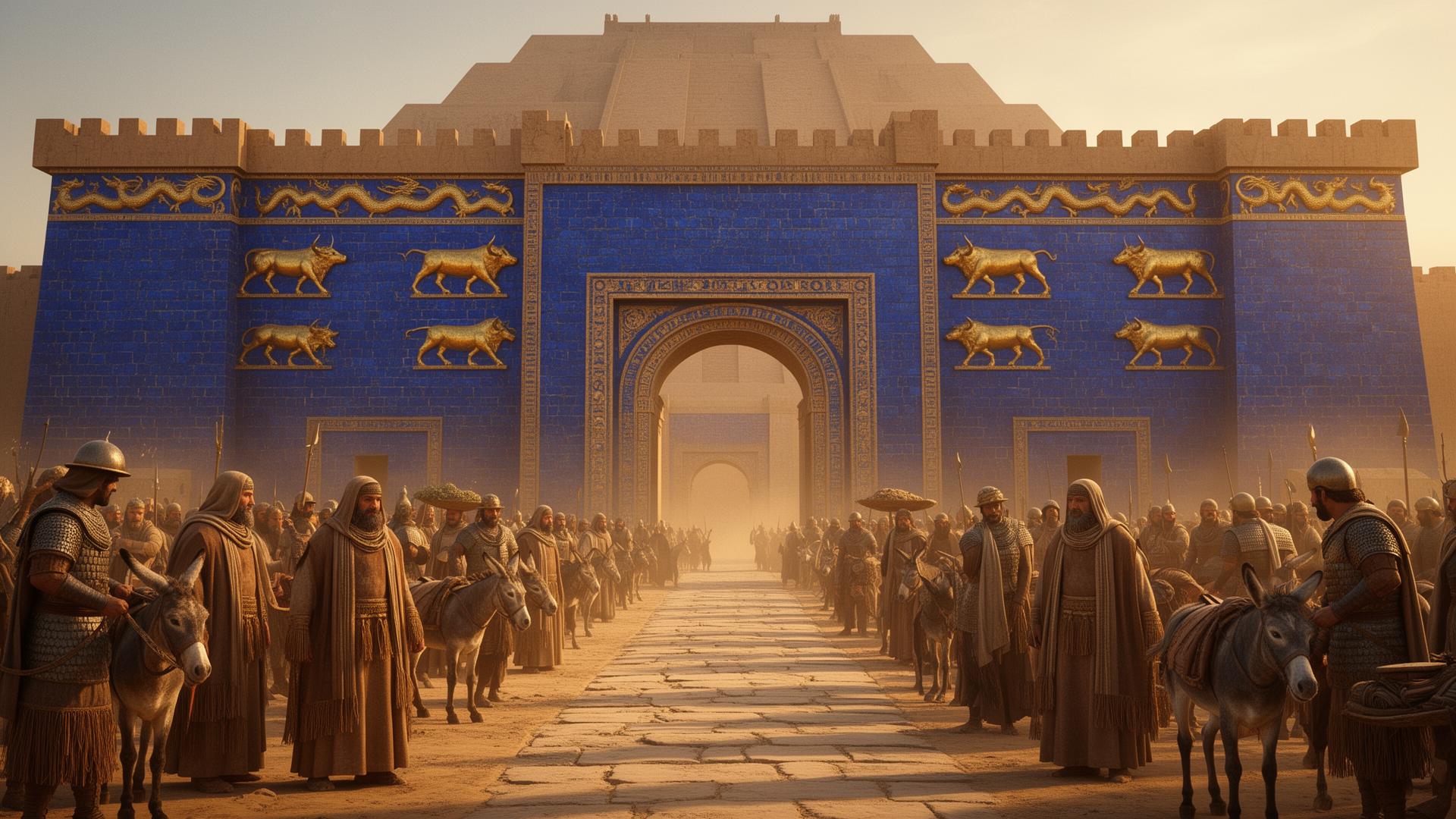
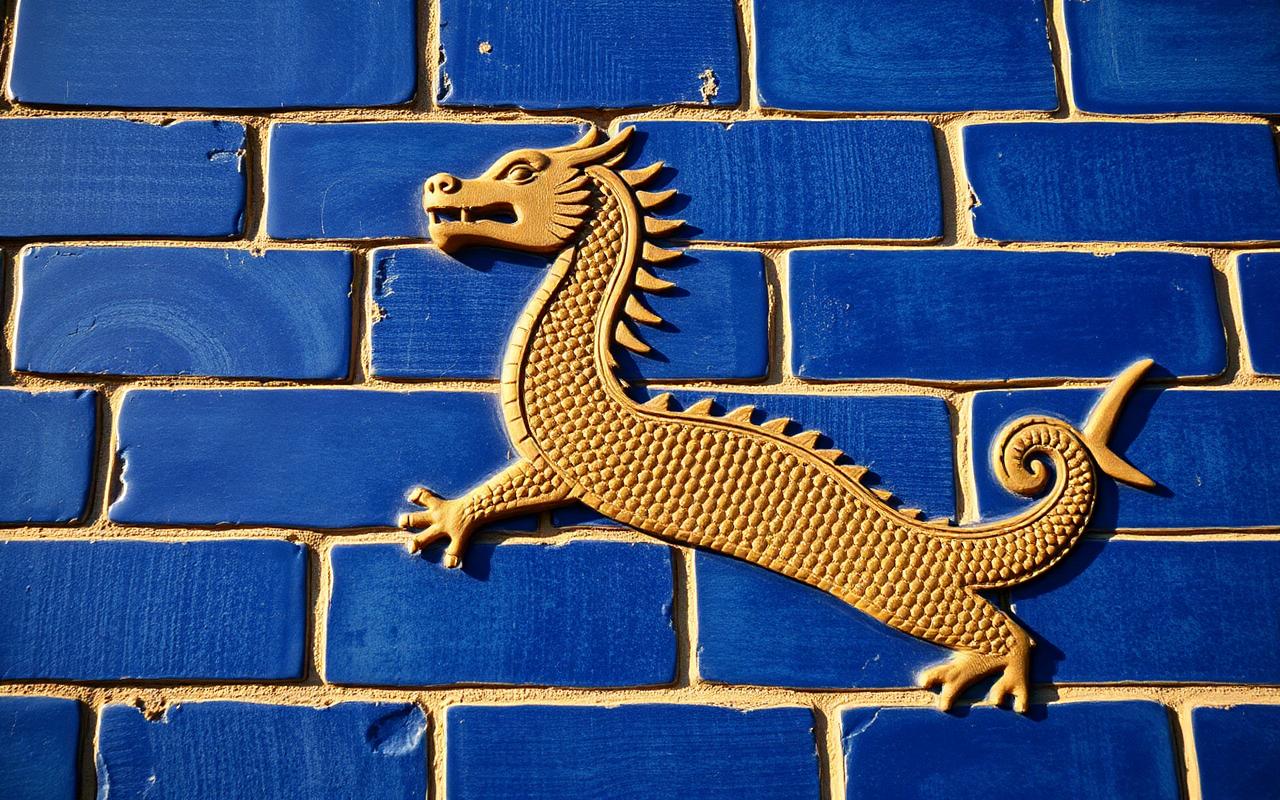
Nebuchadnezzar's Babylon was a planned imperial capital. The Processional Way ran for a kilometer through the city, paved in limestone and red breccia, walled on both sides in glazed brick the color of lapis lazuli, with golden reliefs of striding lions, aurochs, and the mušḫuššu dragon of Marduk. It ended at the Ishtar Gate, then turned toward the great temple precinct of Esagila and the seven-stepped ziggurat Etemenanki - 'House of the Foundation of Heaven and Earth.'
Babylon was also where the world's first systematic astronomy was written down. Scribes in the temple library tracked the planets night after night for centuries on clay tablets; their tables still let modern astronomers retro-calculate eclipses to the minute. Babylonian mathematics gave us the sixty-base division of the hour and the circle.
A day here
From dawn until the lamps go out
You wake in a flat-roofed mudbrick house in the Merkes quarter, on the east bank of the Euphrates. A cock crows from a courtyard; the river smells of mud and tar. Breakfast is barley bread, dates, white cheese, and a small cup of weak beer - the safer drink, since the river water is suspect.
By mid-morning you cross the Euphrates on the great brick-and-cedar bridge into the new city. The Processional Way is already busy: priests in white linen carrying braziers of cedar smoke, merchants from Tyre haggling in Aramaic, Median officers in scale armor, scribes pressing styluses into wet clay for a customs officer at the gate.
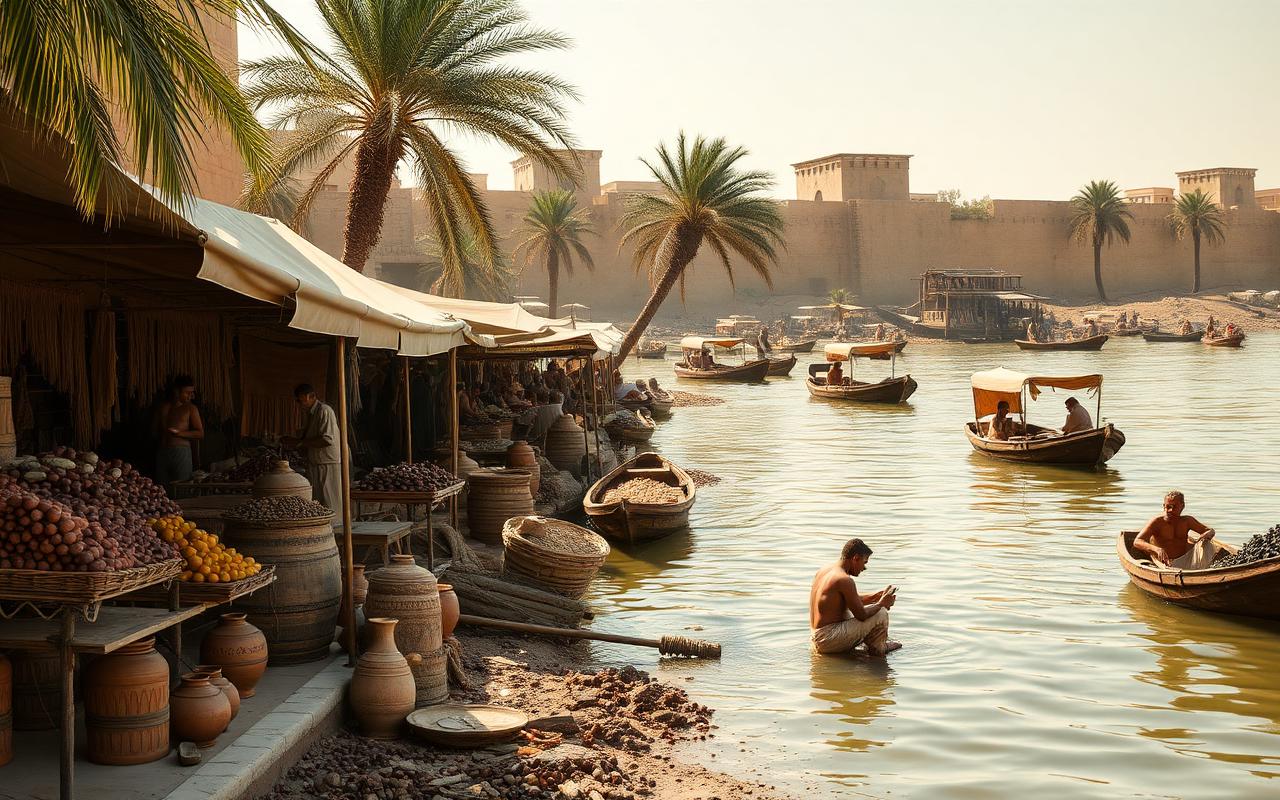
Lunch is a stew of lentils, leeks, and salted fish at a tavern on the harbor, with a beer drunk through a reed straw from a shared jar. Conversation turns to the price of wool, then to a recent eclipse and what it might mean for the king.
The afternoon is spent in the temple precinct of Esagila on minor business: a vow recorded, a small silver shekel weighed out as an offering, a fresh tablet copied of a hymn to Marduk. From the Etemenanki ziggurat you can see the whole plain, green with date palms, threaded by canals.
Evening on a flat roof: a meal of roasted lamb, flatbread, cucumbers, and a dark wine from the hills. The lamps go on along the river and the night air carries the steady rumble of a city that does not sleep, while the scribes on the temple terrace begin another night of watching the sky.
The architecture
How it was built
The people
Who lived here
Babylon was a polyglot city. Babylonian (Akkadian) was the prestige language and the language of the scribes; Aramaic was the street language and increasingly the language of trade across the whole Near East. After Nebuchadnezzar's deportations from Judah and the Levant in the 580s BCE, Hebrew and several other languages were heard along the canals as well.
At the top of society sat the king, his court, and the priesthood of the great temples. Below them were a wealthy merchant class (Babylonian merchants invented many of the instruments of credit and partnership we still use), a large body of free craftspeople and farmers, and at the bottom debt-slaves and war captives.
Religion centered on Marduk, the city god, who had been elevated in the Enūma Eliš to king of all the gods. The New Year festival, the akītu, lasted twelve days each spring; on the most sacred day the king was ritually stripped of his regalia, slapped across the face by the high priest, and only restored to office once Marduk had again been declared king of the gods.
What's real
Nebuchadnezzar's building program (his own foundation cylinders boast about it), the Ishtar Gate (excavated and partially reconstructed in Berlin), the Processional Way, the Etemenanki ziggurat, Babylonian astronomy, the akītu festival, the deportations from Judah.
What's reconstructed
Exact city population, the original colors of the upper city, the soundscape and food. The Hanging Gardens famously have no surviving Babylonian text describing them - they are reported only by Greek and Roman writers and some scholars now place them at Nineveh instead.
What's invented
Nothing here. Where a detail is debated (Hanging Gardens, peak population) it's flagged in the text.
Sources & further reading
- Beaulieu, P-A. - A History of Babylon, 2200 BC – AD 75 (2018)
- Van De Mieroop, M. - A History of the Ancient Near East (3rd ed., 2016)
- Wiseman, D.J. - Nebuchadrezzar and Babylon (Schweich Lectures, 1985)
- Herodotus, Histories I.178–187