Real place · Central Italy, the seven hills above the Tiber
Rome
The marble heart of an empire that ruled fifty million people
- Era
- Founded traditionally 753 BCE; imperial peak under Trajan, c. 98–117 CE
- Region
- Central Italy, the seven hills above the Tiber
- At its peak
- About 1,000,000 - the largest city in the world at the time
- Language
- Latin (street and law); Greek (educated, eastern provinces)
What it was
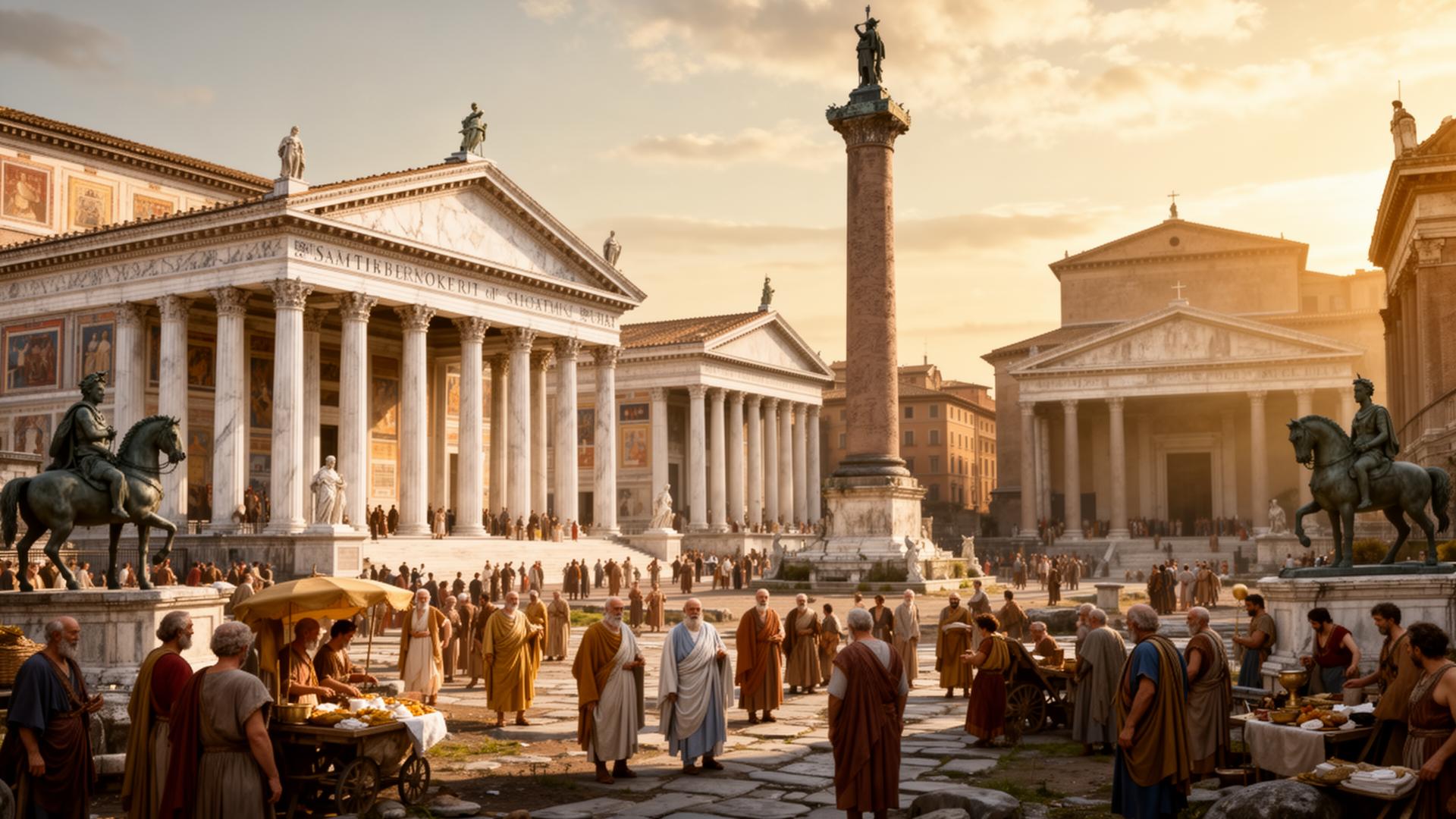
Around 110 CE, in the reign of Trajan, the city of Rome reached a size that no other European city would equal until London in the nineteenth century. Roughly one million people lived inside the Aurelian wall and the suburbs beyond it. The empire they administered ran from the Scottish lowlands to the Persian Gulf and included some fifty to sixty million subjects.
The center was the Forum Romanum, the Forum of Augustus, the Forum of Trajan: marble-paved squares of temples, basilicas, libraries, law courts, and the Curia where the Senate still - formally - met. Above them rose the imperial palaces on the Palatine hill (which gave us the word). Below them ran the Cloaca Maxima, the great sewer that drained the city into the Tiber.
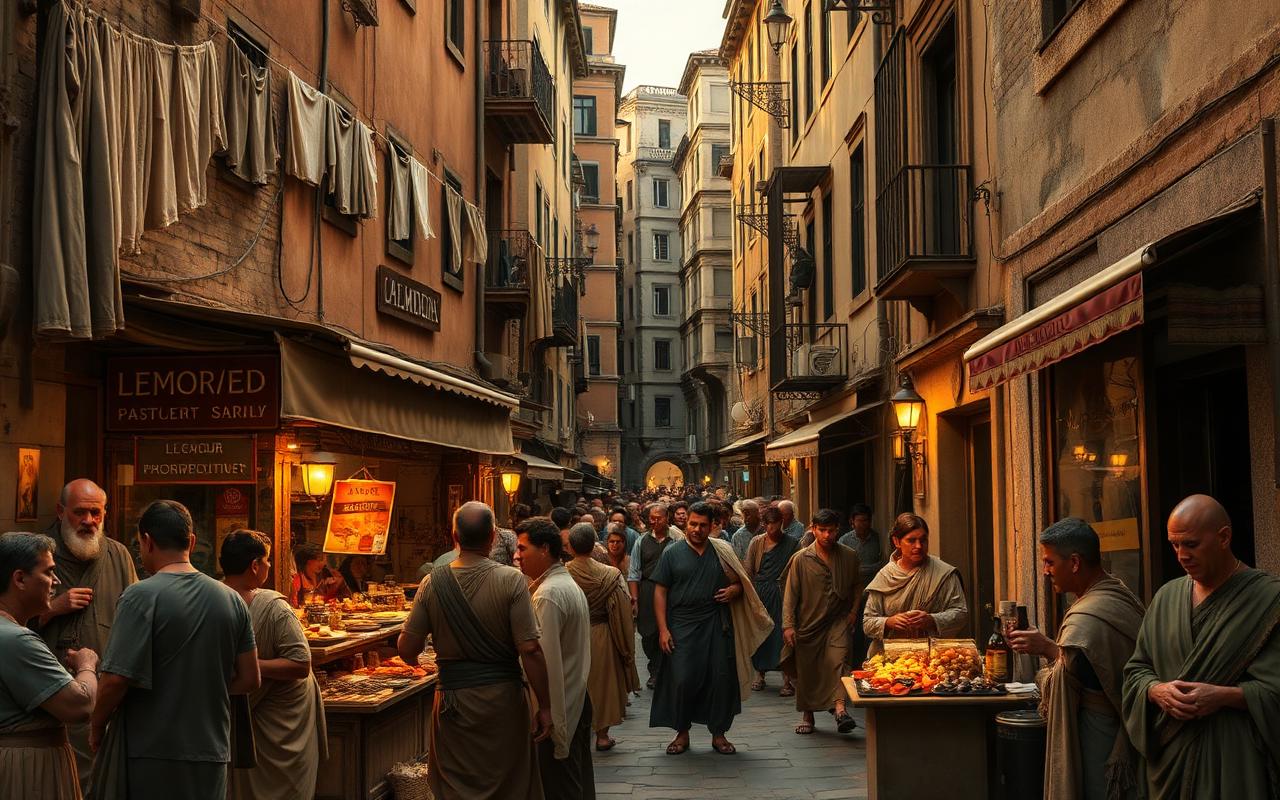
But Rome was also tenement Rome. Most of its million inhabitants lived in insulae - five- and six-story apartment blocks, badly built, regularly burning down, where a one-room flat on the top floor cost less because a fire was likely to find you first. The grain dole (annona) fed perhaps 200,000 male citizens; the public baths cleaned and entertained most of the rest.
A day here
From dawn until the lamps go out
You wake on the fourth floor of an insula in the Subura district at first light, to the racket of an iron-wheeled cart that should not be in the city after dawn (edict of Julius Caesar) and to the smell of yesterday's fish from the shop two floors down. Breakfast is a piece of yesterday's bread dipped in wine.
If you are a client of a wealthy patron you spend the first hour of the morning at his front door for the salutatio - a ceremonial greeting in exchange for a small basket of food, a coin, and the chance to be seen with him in the Forum afterward. The streets are an obstacle course of porters, donkeys, sedan chairs, the smell of bread being baked at the corner, and the occasional aqueduct splash.
Late morning at the Forum on real business: a court case at the Basilica Ulpia, a quick stop at the temple of Castor and Pollux where the bankers keep their tables, a visit to the public library at Trajan's Forum (free, well-lit, two halls - one Latin, one Greek).
Midday is for the baths. Imperial Rome had eleven great public bathhouses by Trajan's time; for a token entry you got hot, warm, and cold rooms, a steam room, a gymnasium, sometimes a library, hours of conversation, and a massage. You leave clean, oiled, and hungry.
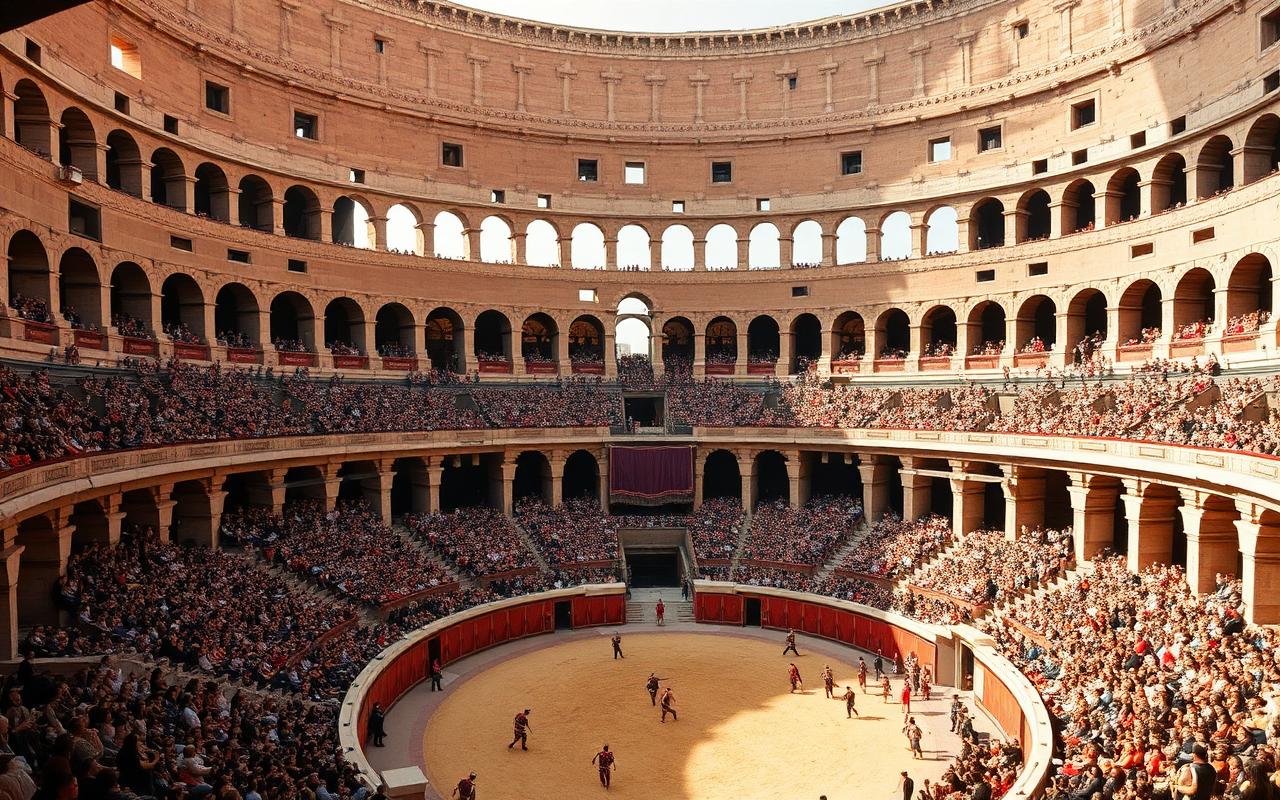
Afternoon and evening: the games. If it's a festival day you walk to the Colosseum (fifty thousand seats, free, with a numbered ticket from your patron) or to the Circus Maximus (a quarter of a million seats for the chariot races). Dinner is on the way home - a hot lentil-and-sausage stew from a thermopolium, eaten standing at the counter, with a cup of cheap watered wine. By nightfall the city of a million is dark; you climb back up your six flights by the light of a small clay lamp.
The architecture
How it was built
The people
Who lived here
Roman society was vertical and rigid. At the top, the senatorial order (a few hundred families); below them, the equites (knights, a wealthy business class); then the plebeians, free citizens; then freedmen (former slaves with limited rights); and at the bottom, the enslaved - perhaps a third of the city's population.
Citizenship was a serious legal status that grew steadily wider through the empire and was extended to almost every free inhabitant of the empire by the Constitutio Antoniniana of 212 CE.
Religion was practiced in layers: the official state cults of Jupiter, Juno, Minerva, and the deified emperors; the popular cults of Isis, Mithras, Cybele, and Sol Invictus brought in from the eastern provinces; and an early Christian community, still a small and intermittently persecuted minority in Trajan's time, that would take another two centuries to come to dominate.
What's real
The fora, the Colosseum, the Pantheon (rebuilt by Hadrian a few decades later, still standing), Trajan's Column (still standing), the aqueducts, the grain dole, the insulae (described by Juvenal, Martial, and the legal codes), the baths.
What's reconstructed
The exact population, the original colors of the temples (most were brilliantly painted; we usually show them white because that's how the marble survives), the daily soundscape.
What's invented
Nothing here. Where a detail (population, attendance figures) is debated, modern estimates are given.
Sources & further reading
- Beard, M. - SPQR: A History of Ancient Rome (2015)
- Carcopino, J. - Daily Life in Ancient Rome (rev. 2003)
- Hopkins, K. & Beard, M. - The Colosseum (2005)
- Juvenal, Satires III; Martial, Epigrams; Pliny the Younger, Letters