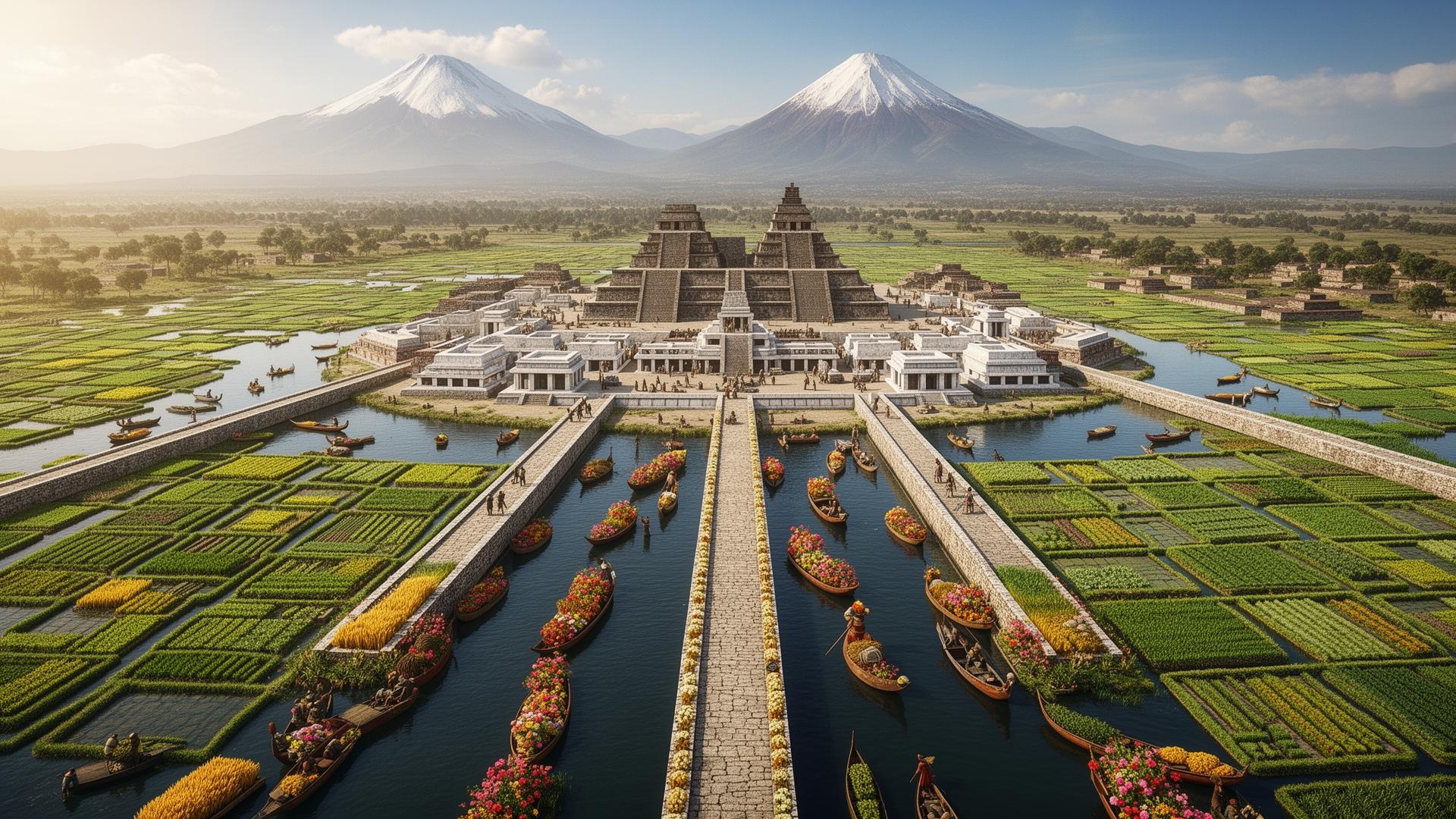
Real place · Lake Texcoco, Valley of Mexico (modern-day Mexico City)
Tenochtitlán
The Mexica island-city Cortés called another Venice
- Era
- Founded 1325 CE; imperial peak under Moctezuma II, c. 1502–1520 CE
- Region
- Lake Texcoco, Valley of Mexico (modern-day Mexico City)
- At its peak
- Around 200,000 in the city; perhaps 1,000,000 in the Valley of Mexico
- Language
- Nahuatl
What it was
The Mexica (the people the Spanish called the Aztecs) founded Tenochtitlán in 1325 on a small uninhabited island in Lake Texcoco, because that was the only land available to them and because, by their own account, they had been told by their god Huitzilopochtli to settle wherever they saw an eagle on a cactus eating a snake. That image is on the modern Mexican flag.
Within two hundred years the Mexica turned a marshy island into one of the largest cities in the world. Three great stone causeways linked it to the lakeshore. Two enormous aqueducts brought fresh spring water from Chapultepec. The city was laid out on a strict grid of streets and canals; the chinampas - long rectangular gardens reclaimed from the lakebed, rooted into the mud and replenished by it - produced multiple crops a year and made the city very nearly self-sufficient in food.
When the soldiers of Hernán Cortés first came over the pass and looked down into the Valley of Mexico in 1519, even men who had seen Venice and Constantinople wrote that they could not quite believe it. Two years later the city was destroyed by siege, disease, and conquest, and Mexico City was built on top of it. You can still visit the excavated foundations of the Templo Mayor a short walk from the Zócalo.
A day here
From dawn until the lamps go out
You wake before dawn in a low whitewashed adobe house in one of the four great quarters of the city. The lake is a sheet of mist. Breakfast is a stack of fresh corn tortillas, a bowl of black beans, a few chiles, and a cup of frothing cacao if you can afford it.
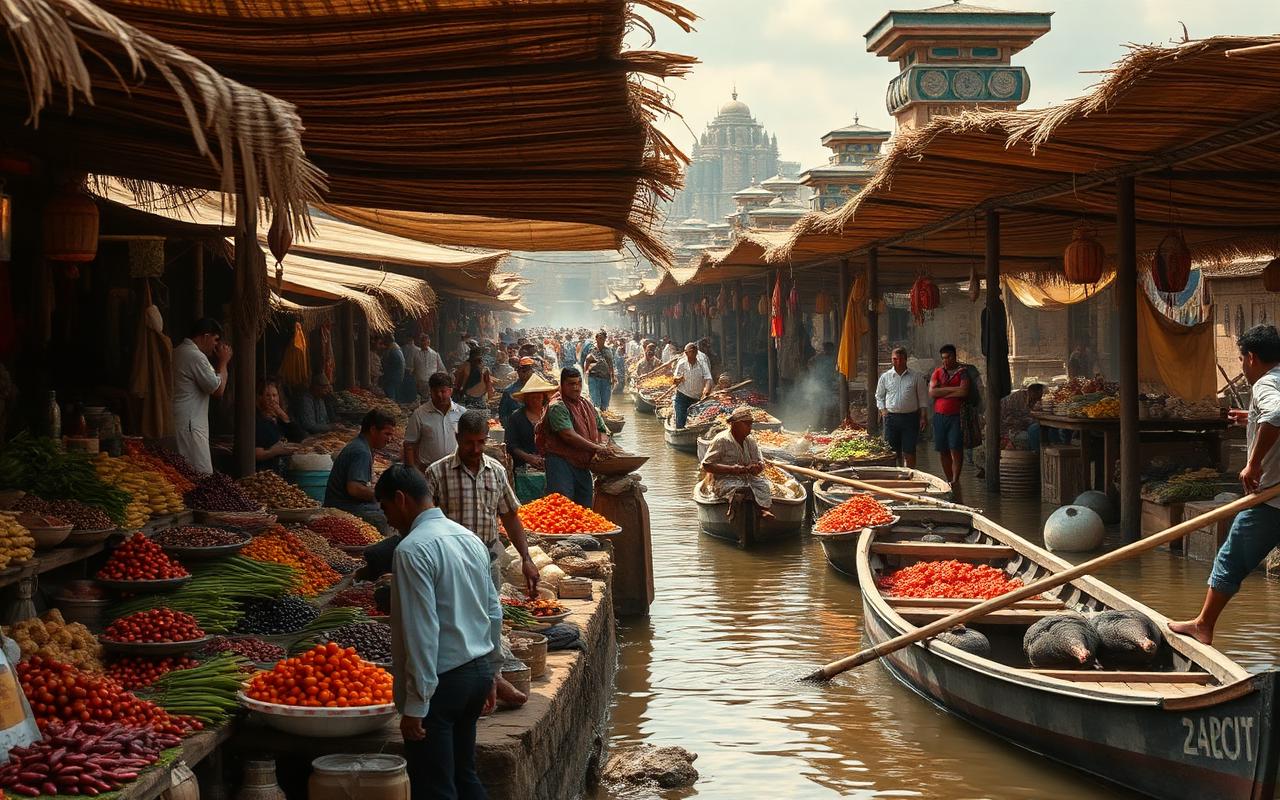
By mid-morning your canoe is poled out along a narrow canal between rows of chinampas - green walls of maize, beans, squash, amaranth, and tomatoes, the soil black with lake mud - toward the great market of Tlatelolco, the largest market the Spanish had ever seen. Sixty thousand traders, said Cortés's chronicler Bernal Díaz, on a single day, each commodity in its own quarter.
Lunch on the move: tamales of corn dough filled with beans and chiles, wrapped and steamed in maize husks, eaten standing by a market stall. You buy a small jade bead for your daughter and a few cacao beans (which double as currency) for change.
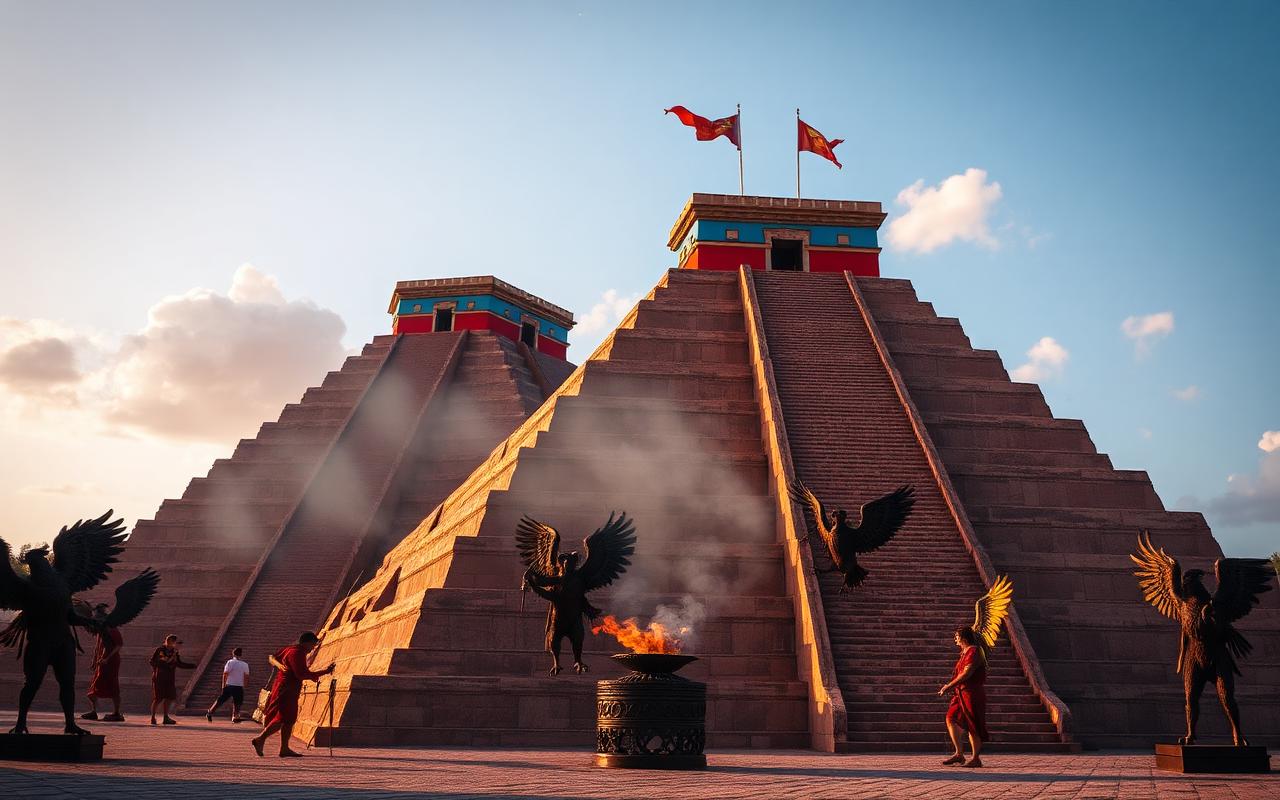
Afternoon in the ceremonial precinct. The twin pyramids of the Templo Mayor - one for Tlaloc, god of rain, painted blue; one for Huitzilopochtli, god of the sun and of war, painted red - rise above the central plaza. A class of calmecac students recites in unison from a folded screenfold book of pictographs. An eagle warrior in a feathered cloak crosses the square; a procession of priests, hair caked with sacrificial blood, climbs the long Huitzilopochtli stair.
At dusk the lamps are lit along the canals and a flotilla of canoes returns home, the city's three causeways closed for the night by removable wooden drawbridges. Dinner is fish from the lake, tamales, more chocolate, and a slow conversation on a flat roof while the snow on Popocatépetl turns pink and the volcano smokes faintly in the distance.
The architecture
How it was built
The people
Who lived here
Mexica society was hierarchical but mobile. At the top sat the huey tlatoani - 'great speaker,' the closest Nahuatl came to 'emperor' - and his council of nobles (pipiltin). Below them were a substantial class of free commoners (macehualtin) organized into city wards called calpolli that held land in common.
A distinct merchant class, the pochteca, ran long-distance trade, often doubling as imperial spies. Craftspeople - featherworkers, goldsmiths, sculptors, scribes - had their own guilds and their own gods.
At the bottom were enslaved people (tlacotin) - often debt-slaves whose status was not hereditary and whose children were born free. Religion centered on a large pantheon - Huitzilopochtli, Tlaloc, Quetzalcoatl, Tezcatlipoca, Xochiquetzal - and yes, included substantial human sacrifice, much of it of war captives whose capture was itself the point of Mexica warfare ('flower wars').
What's real
The city plan (under Mexico City today; the Templo Mayor was excavated starting in 1978 and is open to visitors), the chinampas (still in use at Xochimilco), the codices that survived the conquest (Borbonicus, Mendoza, Florentine), the eyewitness accounts of Cortés and Bernal Díaz del Castillo, the long aqueducts.
What's reconstructed
The exact population (estimates range from 150,000 to 250,000), the original paint colors of the temples, the soundscape of the market.
What's invented
Nothing here.
Sources & further reading
- Townsend, C. - Fifth Sun: A New History of the Aztecs (2019)
- Carrasco, D. - Daily Life of the Aztecs (2nd ed., 2008)
- Bernal Díaz del Castillo - The True History of the Conquest of New Spain (c. 1568)
- Templo Mayor Project - Museo del Templo Mayor, Mexico City